A living privacy screen can help block an unwanted view, soften a fence, reduce wind and make an outdoor space feel more secluded. However, choosing the right screening plants involves more than finding the fastest-growing evergreen at the nursery.
The plant that grows quickly may eventually become too large for the space. A variety that looks narrow in its container may mature into a tree 15 or 20 feet wide. Some plants tolerate North Texas heat and dry soil, while others need more consistent moisture and protection from stressful conditions. Before planting, compare each option’s mature size, growth habit, sunlight requirements and long-term maintenance.
The plant that grows quickly may eventually become too large for the space. A variety that looks narrow in its container may mature into a tree 15 or 20 feet wide. Some plants tolerate North Texas heat and dry soil, while others need more consistent moisture and protection from stressful conditions. Before planting, compare each option’s mature size, growth habit, sunlight requirements and long-term maintenance.
How to choose the right height without overplanting your yard
A privacy planting does not always need to become a 30-foot wall. Many homeowners only need a four to eight foot screen around a patio, pool, porch, equipment area or property line. Choosing a plant that naturally finishes near the required height usually creates a healthier landscape and much less pruning.
Plants must handle long summer heat, periods of drought, alkaline clay or rocky soil and occasional hard winter freezes. Drainage varies from one property to another, so the best plant depends on the site as much as the desired height. The choices below include dependable low, medium and tall options that are commonly suited to the North Texas area.
Plants must handle long summer heat, periods of drought, alkaline clay or rocky soil and occasional hard winter freezes. Drainage varies from one property to another, so the best plant depends on the site as much as the desired height. The choices below include dependable low, medium and tall options that are commonly suited to the North Texas area.
Start with the height you actually need
Stand where privacy matters and identify the exact view you want to block. A seated view across a patio may require only four or five feet of foliage. Screening a neighboring window, commercial property or second story may require a much taller plant. Three to six feet works well for patios, air-conditioning equipment, pool edges and low windows. Six to twelve feet can screen most fences, neighboring yards and outdoor living areas. Fifteen feet or taller is usually needed for elevated views, large buildings or broad property boundaries. The available bed width matters as much as height. A plant that matures ten feet wide cannot remain healthy in a three-foot strip without constant pruning.
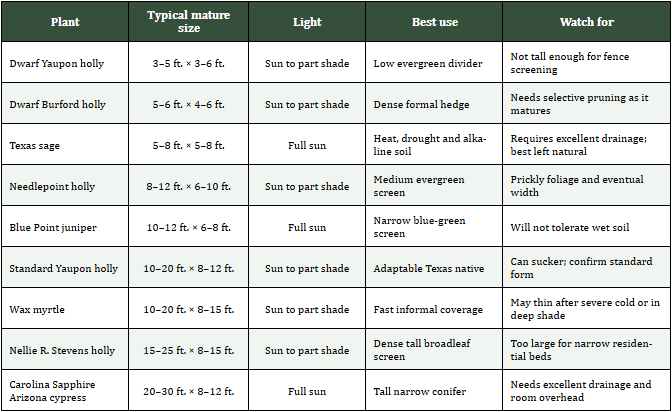
Privacy plant comparison
The sizes below are planning ranges, not guarantees. Mature size changes with cultivar, sun, soil, irrigation and pruning. Always confirm the label for the exact plant you purchase.
Lower screens from three to six feet
Dwarf Yaupon Holly for a low native evergreen border
Dwarf Yaupon Holly is one of the most dependable low evergreens for North Texas. It tolerates heat, drought after establishment, full sun and partial shade. Its small leaves create a fine texture that works well around patios, pools and equipment areas. This plant usually grows wider than it does tall, so it is best for defining a space or blocking a seated view rather than hiding a six-foot fence. It can be clipped, but occasional selective pruning usually preserves a softer and healthier shape.
Best for: A three- to five-foot evergreen boundary in sun or partial shade.
Keep in mind: Make sure the tag identifies a dwarf selection; standard Yaupon becomes much taller.
Best for: A three- to five-foot evergreen boundary in sun or partial shade.
Keep in mind: Make sure the tag identifies a dwarf selection; standard Yaupon becomes much taller.
Dwarf Burford Holly for a dense five-foot hedge
Dwarf Burford Holly is a practical choice when customers want a traditional evergreen hedge without planting a tree-sized holly. It grows densely, tolerates Fort Worth heat and performs in full sun or partial shade. Parker County guidance lists it at about six feet tall and four feet wide, although older unpruned plants can become larger. It responds well to pruning and can hide utility equipment, screen a patio or provide privacy along a short fence. Allow enough room for the plant to stay full from the ground upward.
Best for: A formal evergreen hedge around four to six feet tall.
Keep in mind: Dwarf does not mean tiny. Avoid placing it directly against a wall or narrow walk.
Best for: A formal evergreen hedge around four to six feet tall.
Keep in mind: Dwarf does not mean tiny. Avoid placing it directly against a wall or narrow walk.
Medium screens from five to twelve feet
Texas Sage for hot sunny and dry locations
Needlepoint Holly for medium height and dense foliage
Texas Sage, is native to Texas and well suited to hot, exposed sites with lean, alkaline soil. Its silver foliage and lavender, pink or white flowers add more interest than a plain green hedge. Standard forms commonly grow about five to eight feet tall and wide; compact cultivars may remain closer to three to five feet. Texas Sage needs full sun and excellent drainage. It is not a good choice for a low spot, heavily amended wet bed or area receiving frequent irrigation. It also looks best when allowed to keep its natural rounded form instead of being repeatedly sheared into a box.
Best for: A colorful, drought-tolerant informal screen in full sun.
Keep in mind: Wet soil and overwatering are much more dangerous than drought once the plant is established.
Best for: A colorful, drought-tolerant informal screen in full sun.
Keep in mind: Wet soil and overwatering are much more dangerous than drought once the plant is established.
Needlepoint Holly, fills the gap between a short foundation shrub and a large screening tree. It develops glossy evergreen foliage and can form a dense hedge approximately eight to twelve feet tall when allowed enough width. It accepts sun or partial shade and handles pruning, but its best long-term form comes from choosing a location that can accommodate its natural spread. The foliage has spines, so keep it away from very narrow walkways and high-traffic play areas.
Best for: A six- to twelve-foot evergreen hedge in a moderately wide bed.
Keep in mind: Give it more depth than Dwarf Burford Holly and account for prickly foliage.
Best for: A six- to twelve-foot evergreen hedge in a moderately wide bed.
Keep in mind: Give it more depth than Dwarf Burford Holly and account for prickly foliage.
Blue Point Juniper for a narrower upright screen
Blue Point Juniper is a dense, blue-green conifer that commonly matures near twelve feet tall and eight feet wide. It tolerates heat, cold, drought and poor soils once established, making it a strong option for a sunny Fort Worth landscape. Its naturally pyramidal shape can create vertical privacy without the enormous mature size of Eastern Red Cedar. It should be planted in full sun with good drainage and enough air movement. Like other junipers, it can develop bagworms, so inspect the foliage regularly.
Best for: A narrow, structured screen or evergreen accent in full sun.
Keep in mind: Do not plant it in soil that remains wet, and do not cut deeply into old bare wood.
Best for: A narrow, structured screen or evergreen accent in full sun.
Keep in mind: Do not plant it in soil that remains wet, and do not cut deeply into old bare wood.
Taller screens for larger spaces
Standard Yaupon Holly for adaptable native screening
Standard Yaupon Holly is a much larger plant than the dwarf form. It can be grown as a large multi-stem shrub or trained as a small tree and tolerates sun, partial shade, drought, temporary wet conditions and a wide range of soils. The small evergreen leaves create a natural-looking screen, while female plants can produce red berries when pollination is available. It is especially useful in a mixed screen where native value and wildlife support are priorities.
Best for: An adaptable native screen approximately ten to twenty feet tall.
Keep in mind: Standard forms may sucker. Remove unwanted shoots if a clean hedge is desired.
Best for: An adaptable native screen approximately ten to twenty feet tall.
Keep in mind: Standard forms may sucker. Remove unwanted shoots if a clean hedge is desired.
Nellie R Stevens Holly for substantial evergreen privacy
Nellie R. Stevens Holly remains one of the best choices when a genuinely tall, dense broadleaf screen is needed. It tolerates North Texas heat, accepts sun or partial shade and can form a polished year-round barrier. Its mature size is also the reason it is often planted in the wrong place. A plant that can reach fifteen to twenty-five feet tall and more than eight feet wide should not be squeezed into a narrow strip between a driveway and fence.
Best for: Tall screening where there is enough bed depth for a large holly.
Keep in mind: Choose Dwarf Burford or Needlepoint Holly when the desired screen is under twelve feet.
Best for: Tall screening where there is enough bed depth for a large holly.
Keep in mind: Choose Dwarf Burford or Needlepoint Holly when the desired screen is under twelve feet.
Wax Myrtle for fast informal coverage
Wax Myrtle is a fast-growing native shrub or small tree with fine-textured aromatic foliage. It creates a softer, more natural screen than a row of clipped hollies and is useful along broad property lines or behind mixed landscape beds. It accepts full sun or partial shade and a range of soil moisture after establishment. In the Fort Worth area, severe cold may temporarily thin the foliage or damage exposed growth, so use it where a slightly informal appearance is acceptable.
Best for: Fast native coverage in a broad, informal planting bed.
Keep in mind: It needs adequate width and may not remain perfectly dense after severe winters.
Best for: Fast native coverage in a broad, informal planting bed.
Keep in mind: It needs adequate width and may not remain perfectly dense after severe winters.
Carolina Sapphire Arizona Cypress for tall narrow screening
Carolina Sapphire is a blue-green selection of Arizona Cypress that handles heat, sun and dry conditions better than many commonly marketed screening conifers. Its upright form is useful where a tall screen is needed but a broad tree such as Eastern Red Cedar would consume too much width. This cypress must have well-drained soil. Avoid low areas, overwatered lawns and sites where runoff collects around the roots. Plan for its full height and keep it clear of overhead utilities.
Best for: A tall conifer screen in full sun on a well-drained site.
Keep in mind: Poor drainage is the primary concern; it is still too large for a small foundation bed.
Best for: A tall conifer screen in full sun on a well-drained site.
Keep in mind: Poor drainage is the primary concern; it is still too large for a small foundation bed.
Plants we would use more selectively
Eastern Red Cedar is extremely tough and native to North Texas, but the species becomes a large tree and is better suited to acreage, windbreaks and broad property boundaries than most residential beds. Little Gem Magnolia is beautiful, but it generally closes a screen more slowly and prefers more consistent moisture than our toughest holly, juniper and Texas Sage options. Both can still be excellent plants when the site and goal truly fit them.
We also use caution with plants that are fast but unreliable after severe freezes, require acidic soil or spread beyond the intended landscape. A plant should not be recommended for privacy only because it grows quickly in its first few years.
We also use caution with plants that are fast but unreliable after severe freezes, require acidic soil or spread beyond the intended landscape. A plant should not be recommended for privacy only because it grows quickly in its first few years.
A mixed screen can be more resilient
A straight row of one species creates a formal appearance, but every plant shares the same vulnerabilities. A mixed screen repeats a few compatible plants in staggered groups, adding depth and reducing the chance that one pest, disease or weather event creates a complete opening.
For example, a larger property could combine Carolina Sapphire Cypress for height, Standard Yaupon Holly for dense native foliage and Texas Sage along the sunny front edge. A smaller yard might use Needlepoint Holly at the back, Dwarf Burford Holly near the patio and ornamental grasses or flowering shrubs in front. Match all plants in each irrigation zone to similar water and drainage needs.
For example, a larger property could combine Carolina Sapphire Cypress for height, Standard Yaupon Holly for dense native foliage and Texas Sage along the sunny front edge. A smaller yard might use Needlepoint Holly at the back, Dwarf Burford Holly near the patio and ornamental grasses or flowering shrubs in front. Match all plants in each irrigation zone to similar water and drainage needs.
Spacing matters more than instant coverage
Young nursery plants often look too far apart when spaced for maturity. Planting them closer may create privacy sooner, but the roots and branches eventually compete for light, water and air. Crowded plants require more pruning and are harder to inspect or treat. Use the expected mature width of the exact cultivar as the starting point for center-to-center spacing. Plants intended to overlap can be placed somewhat closer, but leave access between the screen and fences, walls or neighboring property. If immediate privacy is essential, consider starting with larger containers rather than placing too many plants in the bed.
Planting and establishment basics
- Plant from fall through early spring when possible, provided the soil is workable and irrigation is available during dry weather.
- Dig the hole wider than the root ball but no deeper. Keep the root flare at or slightly above the surrounding grade.
- Check drainage before choosing Texas Sage, Juniper or Arizona Cypress. These plants will not tolerate constantly wet roots.
- Water the root ball deeply after planting and monitor it separately from the surrounding soil.
- Apply two to three inches of mulch over the root zone while keeping mulch several inches away from trunks and stems.
- Do not depend on drought tolerance during the first growing season. Resilience develops as the root system becomes established.
Bring measurements and photos before you shop
A useful privacy-screen plan begins with the length of the area, available bed depth and desired finished height. Bring clear photos taken from both directions, the number of hours of direct sun and notes about drainage or irrigation. Those details help us recommend plants that fit the site instead of simply selling the tallest option available.
Color Crop Nursery can help you compare current plant choices for your property. If the project needs a complete layout, bed preparation and installation, James Signature Outdoors can also help create a screen that works with the rest of the landscape.
Color Crop Nursery can help you compare current plant choices for your property. If the project needs a complete layout, bed preparation and installation, James Signature Outdoors can also help create a screen that works with the rest of the landscape.